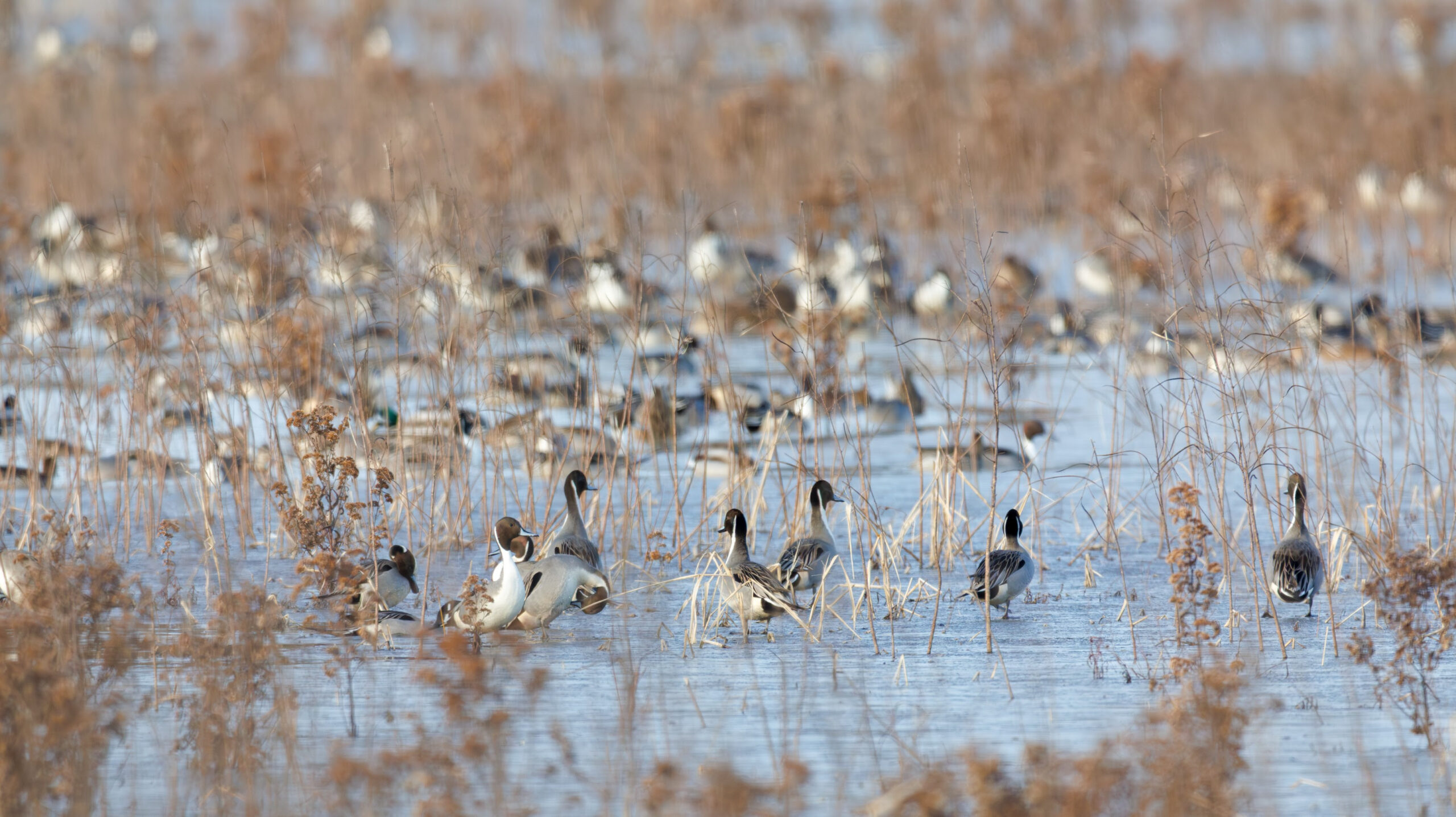
Arkansas Game and Fish Commission biologists estimated a significantly higher number of mallards in the Delta than were counted this time last year during their annual December aerial survey.
Biologists conducting a transect-based survey from Dec. 15-23 estimated a mallard count that was 344,741 birds above a meager December 2024 count, with an estimated total of 498,164 seen.
That total estimate is 35,154 mallards below the 2009-2024 December long-term average, says Brett Leach, the AGFC’s waterfowl program coordinator.
Total ducks in the Delta numbered 928,377 ducks over the same December estimate last year, with a total of 1,458,354 ducks estimated, Leach wrote in his report issued this week. The total was 407,455 ducks over the estimated long-term average for the December survey.
Arctic goose population estimates totaled 2,992,914 light (lesser snow and Ross’s) geese and 285,292 greater white-fronted geese in the Delta.
Weather and aircraft maintenance delays led to a later-than-usual December estimating period, which didn’t wrap up until right before Christmas for the Delta. Equipment problems with aircraft scratched the annual December count for the Arkansas River Valley, but Leach said the River Valley is scheduled to be flown in early January for Arkansas’s annual mid-winter survey.
Staff also performed a cruise survey Dec. 10 in southwest Arkansas and estimated 7,960 total ducks, with 3,710 of those being mallards. Duck numbers in that region remain significantly lower than historical norms.
Mallard counts trailed the December long-term average by 69% in southwest Arkansas, while total duck populations were 74% below average. Of the mallards recorded, the majority (61%) were concentrated along the Red River between U.S. Highway 82 and the Sulphur River.
On average in the Delta, mallards account for about 49% of all ducks during December surveys. During this survey period, mallards made up only 34% of the total duck estimate, a similar trend for recent, dry Decembers in The Natural State.
“During periods of drought, estimates may be biased high or low due to the clumped distribution of birds around limited water sources, introducing greater uncertainty into the estimates,” Leach wrote in his report. “This spatial clustering, evidenced by observer reports of large concentrations along specific transects, likely biased our estimates upward. The resulting uncertainty is reflected in the wide confidence intervals; for instance, the mallard estimate of 498,164 had a confidence interval of 297,292 to 797,901 birds, suggesting the true number of mallards in this region could range from about 297,000-798,000 birds.”
He wrote that similarly, because of the clustering of birds around limited water sources, the total duck estimate had a wide confidence interval of between 817,000 to 2.31 million birds.
“Consequently, confidence in these population estimates is lower than typical surveys,” he stated.
Leach said the biologists estimated over 50,000 mallards in four survey zones: the Bayou Meto-Lower Arkansas, Big Creek in eastern Arkansas, Cache and L’Anguille rivers. These survey zones accounted for 79% of the MAV-wide mallard estimate and 76% of the total duck estimate. In addition, the Black-Upper White survey zone had a relatively high total duck estimate of 106,953.
Most notably, the Big Creek zone had 429,157 total ducks, which made up 29% of the total duck estimate.
Hot spot maps indicate several key duck concentration areas primarily in the central to east-central portion of the Delta.
The report noted that the Delta has faced extremely dry conditions this fall without any substantial rainfall, with the majority of the region currently classified as moderate to severe drought conditions. Observed rainfall totals in November and December were about 62% below normal in central Arkansas.
Leach wrote in his report: “While the current forecast includes light precipitation after the New Year, it lacks the volume necessary to alleviate the deficit. Early in the survey period, icy conditions caused ducks to congregate in tight clusters; however, subsequent warming allowed the birds to disperse across the landscape a bit more.”
AGFC Wildlife Management Division employees Tristan Bulice, Casey Guy and Derek Furr conducted the first aerial survey of the season, with Bulice and Guy flying the Delta. Leach said he will be joining them next week to fly the Arkansas River Valley.
Surveys are scheduled to begin Jan. 5. See the latest survey and the maps of duck distribution around the state here.