The Arkansas Game and Fish Commission in September approved a budget increase of $5.1 million for the agency’s Private Lands Habitat Division to fund habitat improvements and public hunting opportunities on private land. The money for this increase comes from a combination of governor’s set-aside restricted reserve funds and a recently awarded Voluntary Public Access Grant from the Natural Resources Conservation Service.
“Five million dollars of this increase comes from Gov. Sarah Sanders’ set-aside that was approved by the General Assembly to fund our Conservation Incentive Program,” Garrick Dugger, chief of the AGFC’s Private Lands Habitat Division, said.
The remaining $100,000 of the budget increase will complete the implementation of this year’s Waterfowl Rice Incentive Conservation Enhancement Program. The WRICE program not only offers financial incentives for rice producers to forgo fall tilling of their fields and flood that acreage for waterfowl habitat, but also opens these enrolled rice fields to limited public access through draw hunts conducted during duck season.
“The money for this program comes from the recent $2.1 million Voluntary Public Access Grant awarded to the AGFC to be used in the next three years,” Dugger said. “Thanks to this grant, we’ll be able to continue this program that helps keep flooded rice on the landscape at a time when flooded winter acreage is facing a sharp downturn. We’ve lost nearly a third of last year’s rice acreage to other crops this year due to economic drivers making it very difficult for rice farmers to make a profit on their crops. This, plus the ongoing drought, makes every flooded acre of open fields critical to winter waterfowl habitat.”
The Commission devoted much of the remainder of the September meeting to presentations on wind and solar energy development in Arkansas and how it may shift future wetland habitat use by both waterfowl and waterfowl hunters. Advancements in wind energy technology have made wind turbines more effective in Arkansas, leading to increased interest in their use.
Commissioners Brandon Adams and Philip Tappan both stressed that the agency is not a regulatory authority over wind and solar energy, but has recently been included in the Arkansas Wind Energy Development Act 945 as one of the agencies to which proposed facilities must report their plans before construction. The AGFC’s role in these plans is to review proposals and educate prospective facility owners about possible effects this infrastructure may have on wildlife and wildlife habitat in The Natural State.
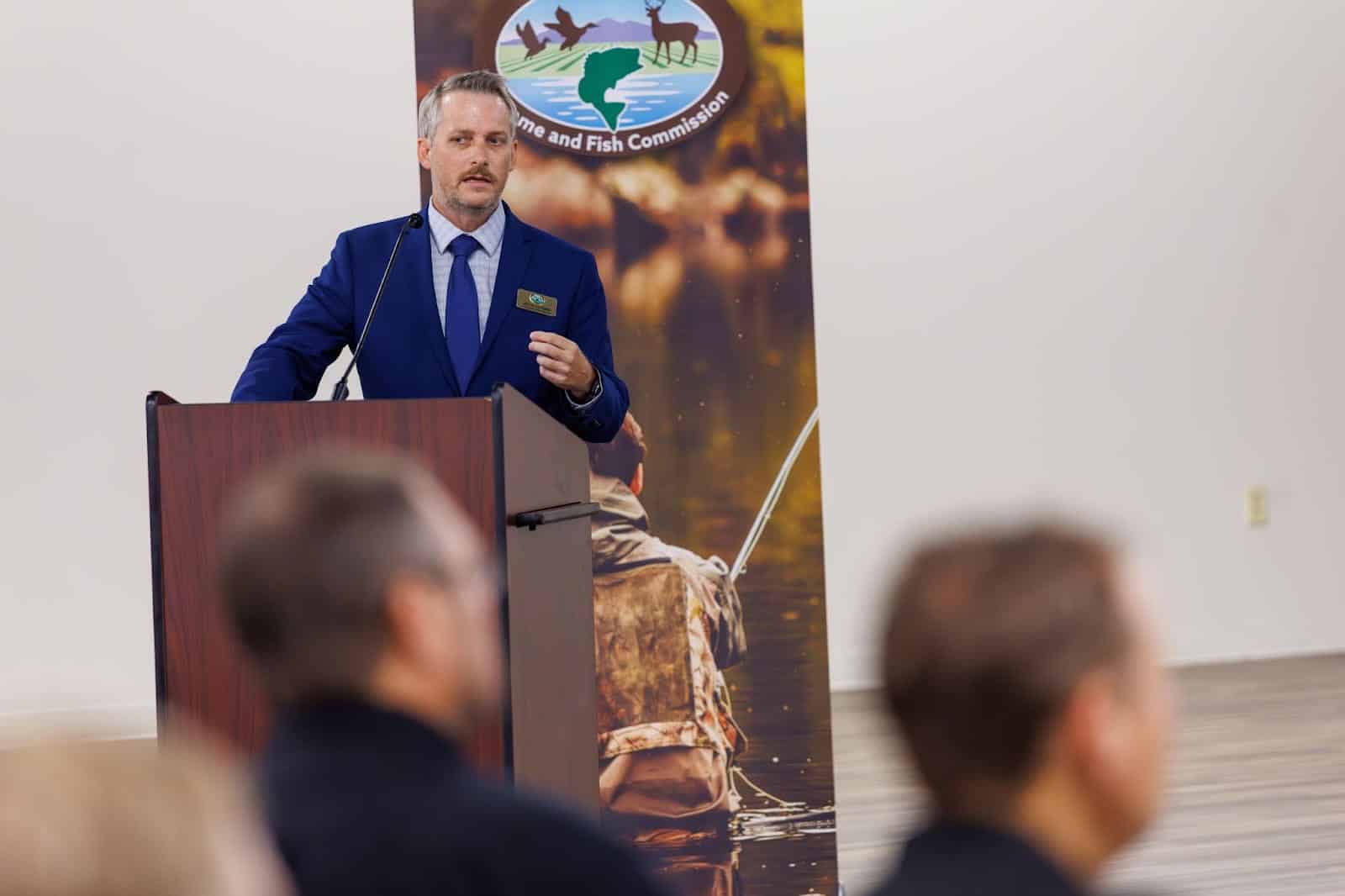
The topic began with an in-depth presentation by Justin Stroman and Ellery Lassiter, who work in the agency’s Conservation Support Division, on the AGFC’s involvement in reviewing wind energy projects and how these facilities may affect wildlife populations, including endangered species, bats and migratory birds. Stroman led the presentation with a primer on the agency’s increased role in advising companies planning to construct facilities in the state. Lassiter followed with a brief overview of the many research projects the AGFC is coordinating specifically on waterfowl density and possible habitat-use shifts after the installation of these energy facilities.
J.D. Wilson, vice chair of biological sciences at the University of Arkansas, spoke about the possible effects of solar energy facilities on wildlife. According to Wilson, the rate of solar expansion and size of solar facilities have increased massively throughout the Southeast in the last two decades, outpacing research on possible impacts on wildlife such as pollinators, which are critical to Arkansas agriculture. Many solar farms require large, undisturbed grasslands underneath the panels, which could, with the proper planning, become beneficial to grassland species, which make up a large portion of Arkansas’s species of greatest conservation need.
Joe Lancaster from Ducks Unlimited wrapped up the wind energy discussion with a presentation on the recent research coordinated by DU in Louisiana, Mississippi and Arkansas concerning waterfowl species diversity and densities in the Lower Mississippi Alluvial Valley and its correlation with various environmental conditions and land-use patterns. Maps and geospatial information resulting from this research promise to be valuable to municipalities in decision-making on the placement of proposed projects.
The Commission also unanimously approved the official name of the state’s latest wildlife management area as Pat Fitts Oakwood WMA. Pat Fitts Oakwood WMA was added to the AGFC’s hunting opportunities earlier this year, thanks to a land trade between the agency and the U.S. Fish and Wildlife Service.
Fitts’ steadfast commitment to conservation and the people of Arkansas was evident throughout his 32-year career with the agency. He was a calming influence throughout one of the agency’s and the country’s most trying times — the COVID-19 pandemic. In the face of a world shutting down, Fitts led the AGFC to the completion of the J.B. and Johnelle Hunt Family Nature Center in Springdale and led the charge to begin renovation of the Joe Hogan State Fish Hatchery in Lonoke, the AGFC’s oldest and largest fish hatchery.