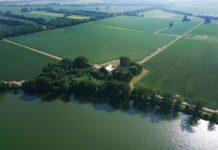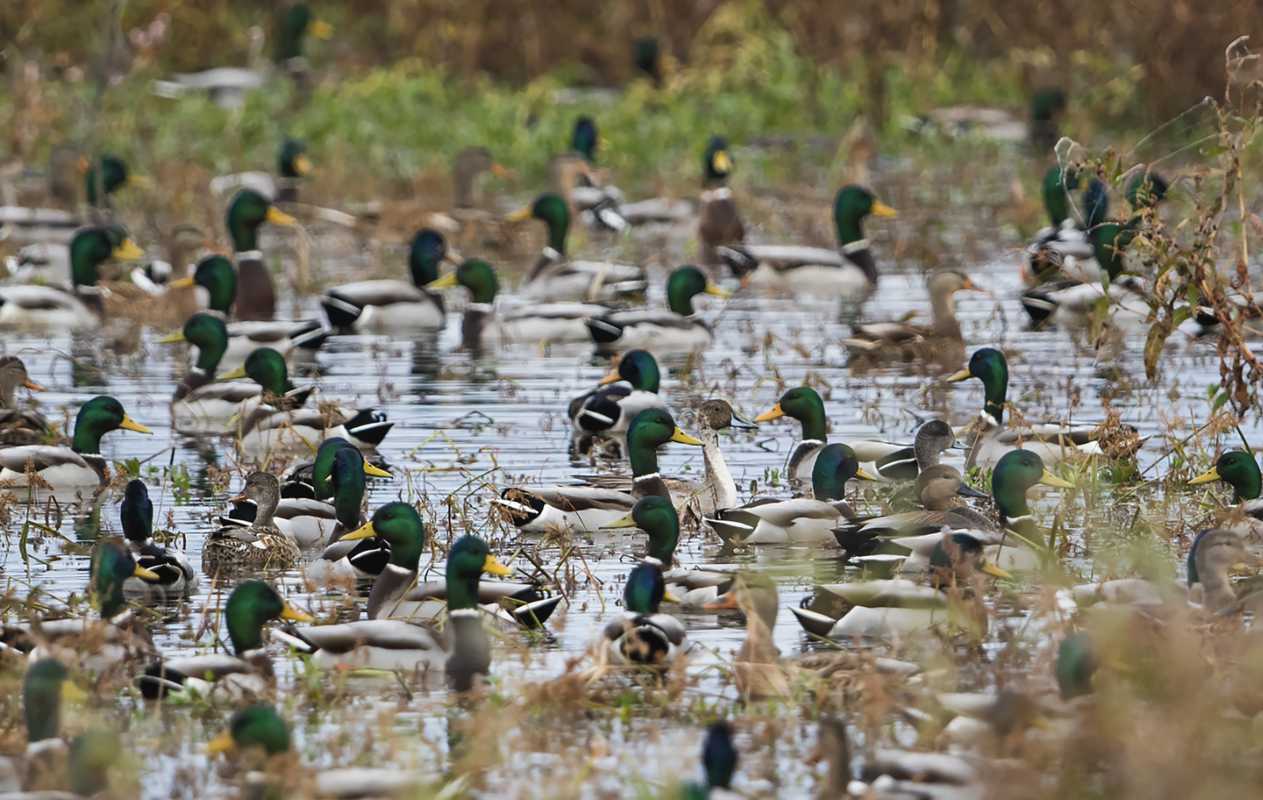
Both private and public land managers want more mallards. Managing for mallards, at its core, is managing shallow, flooded early successional wetlands that produce high-carbohydrate seeds and grains. Other wetlands are maintained in mid- to late-successional perennial cover — seasonally flooded bottomland hardwoods, emergent marshes and cypress brakes.
The flipside of that is the redistribution concern. Intensive habitat management on private lands may be concentrating birds, while public lands and the average lease struggle for quality mallard hunting. Public lands absorb the full pressure of guns and boats, and private ground in Arkansas has paid the price for improvements in modern agriculture. Now, a flooded rice field in eastern Arkansas simply does not provide the duck energy days it did 30 years ago.
So the central question becomes this: Is intensive habitat management pulling birds off the landscape and ruining hunting for the neighbors? Or are declining habitat quality and mounting pressure across the landscape forcing mallards onto the few high-quality, managed properties that remain?
Within-State Redistribution and Survey Data
Winter surveys conducted by the Arkansas Game and Fish Commission indicate some recent reductions in wintering mallard numbers, and part of that pattern is consistent with declining breeding populations over the past decade.
But population decline alone may not tell the whole story. One could argue that mallards have increasingly concentrated on a smaller number of high-quality, intensively managed wetland complexes, many of which may fall outside survey routes. Properties managed for moist-soil vegetation, flooded row crops and minimal disturbance routinely hold thousands to tens of thousands of mallards with notable year-to-year consistency.
This concentration effect suggests that some declines inferred from survey data may reflect changes in detectability and distribution rather than a true reduction in the number of mallards wintering in Arkansas. In that sense, Arkansas may be better described as a landscape experiencing increasing polarization between high-quality managed habitat and increasingly marginal surrounding areas, rather than one simply losing mallards across the board.
Short-Stopping and the Latitude Problem
These redistribution effects do not operate only within Arkansas; they play out across the entire flyway. An abundance of grain and managed moist-soil habitat in other states attracts and holds large concentrations of mallards. The question is whether that abundance prevents birds from moving in search of calories when food sources are exhausted, distributing latitudinally and longitudinally as they once did.
The conventional short-stopping narrative treats this as a modern aberration: birds held north of their natural wintering range by anthropogenic food subsidies. But that framing may itself reflect a limited historical baseline.
Mallards in the Mississippi Flyway do winter across a broadly predictable latitudinal band, roughly from Missouri to the Louisiana coast, but the center of gravity within that range has likely never been fixed. What modern agriculture has likely done is make certain locations so reliably productive that they function as caloric anchors, reducing the year-to-year variance in distribution.
What we call short-stopping is not necessarily a deviation from a natural baseline, but the latest chapter in a longer story of birds tracking calories across a landscape that humans have been reshaping for more than a century.
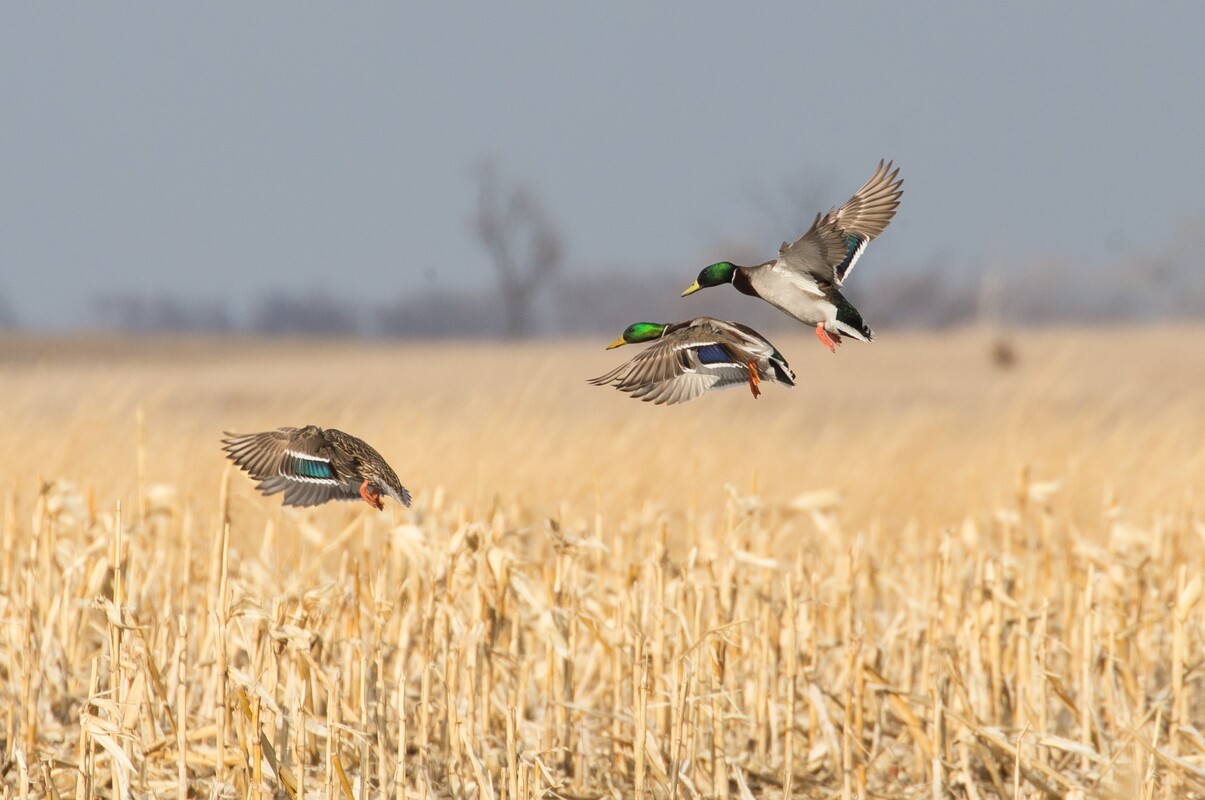
The same agricultural transformation that made the Grand Prairie a legendary duck destination in the early 20th century may now be contributing to birds stacking in Missouri without ever arriving. Arkansas benefited enormously from being one of the first grain-on-water landscapes in the flyway. It may now be on the receiving end of that same dynamic playing out one latitude to the north.
Accidental Impoundment
One major factor that made Arkansas — and the Grand Prairie in particular — famous among waterfowlers was the expansion of rice farming at the turn of the 20th century. W.H. Fuller planted the first successful commercial rice crop near Hazen in 1904, and within a generation, the native prairie had been converted into one of the most productive mallard landscapes on the continent.
What’s easy to forget is why those fields were so extraordinary. Inefficient harvest machinery, late harvest dates, fields rendered unharvestable by fall rains and the early practice of cutting rice and leaving it bundled in shocks to cure in the field all deposited waste grain in significantly larger quantities than modern harvesting. The closest comparison today would be planted food plots — systems of that same kind of concentrated food resource we intentionally produce. Those fields were, functionally, accidental food plots. The Grand Prairie largely became famous because industrial-scale rice farming created an enormous and reliable caloric subsidy directly on shallow, flooded ground, and the development of green timber reservoirs adjacent to those rice fields created a mallard-hunting mecca.
That caloric subsidy, however, has largely disappeared across the MAV. Research estimates vary, but fall tillage, early harvest and harvesting efficiencies have reduced rice waste grain in the region by an estimated 60% since the 1980s.
Meanwhile, the opposite dynamic appears to be unfolding farther north. Across much of the Midwest, corn production has expanded significantly, and the widespread adoption of no-till and reduced-till practices has left grain accessible on the landscape. Where the MAV is losing grain through tillage, the Midwest may be gaining it.
But the same logic that explains why wintering-ground agriculture helps mallards also exposes the limits of what winter-habitat management can accomplish. Agriculture in the Prairie Pothole Region has had devastating effects on the very engine that produces mallards in the first place. Wetland drainage and grassland tillage have removed millions of acres of breeding and brooding habitat.
No amount of food on the wintering grounds can compensate for a PPR that is producing fewer birds each year.
Gulf Coast Habitat Loss and Northward Redistribution
The Gulf Coast provides one of the clearest examples of how land-use change can alter wintering waterfowl distributions. Over recent decades, the region has experienced declines in rice acreage, expansion of crawfish farming and extensive coastal wetland loss driven by saltwater intrusion.
As those changes have accumulated, shallow freshwater habitats suitable for dabbling ducks have diminished. In Louisiana and across the broader Gulf Coast, this has coincided with a shift in species composition away from grain-eating mallards toward teal, gadwall, divers and other species better adapted to more saline and less grain-rich wetlands.
A prime example of land-use-driven winter redistribution is the northward movement of snow geese and white-fronted geese. Snows and specks, historically associated with Gulf Coast wintering areas, have pushed into Arkansas and surrounding MAV states. Rice acreage along the Texas and Louisiana Gulf Coast has declined sharply since the 1970s, reducing traditional foraging areas and shifting these birds toward interior agricultural landscapes where grain remains available. Today, Arkansas has emerged as a major winter destination for both species.
Climate as Amplifier
Disentangling land use from climate as drivers of mallard distributions is complicated by the fact that both forces produce overlapping effects and operate simultaneously. Smaller-bodied, cold-sensitive species such as teal and gadwall respond more predictably to cold fronts and push south more readily, while mallards, being larger and more energetically flexible, can hunker down during cold snaps and exploit food resources farther north in mild winters. That behavioral difference means warming winters may have an outsized short-stopping effect on mallards specifically.
One possible explanation is that climate change modifies how birds respond to habitat conditions that land-use has already transformed. A milder winter does little for mallards in a pasture; there is little to hold them regardless of temperature or snow cover. But where land-use change has introduced high-carbohydrate waste grain — as the expansion of corn production has done across much of the Midwest — milder winters may extend the window during which those areas remain accessible. Climate amplifies what land use has already built.
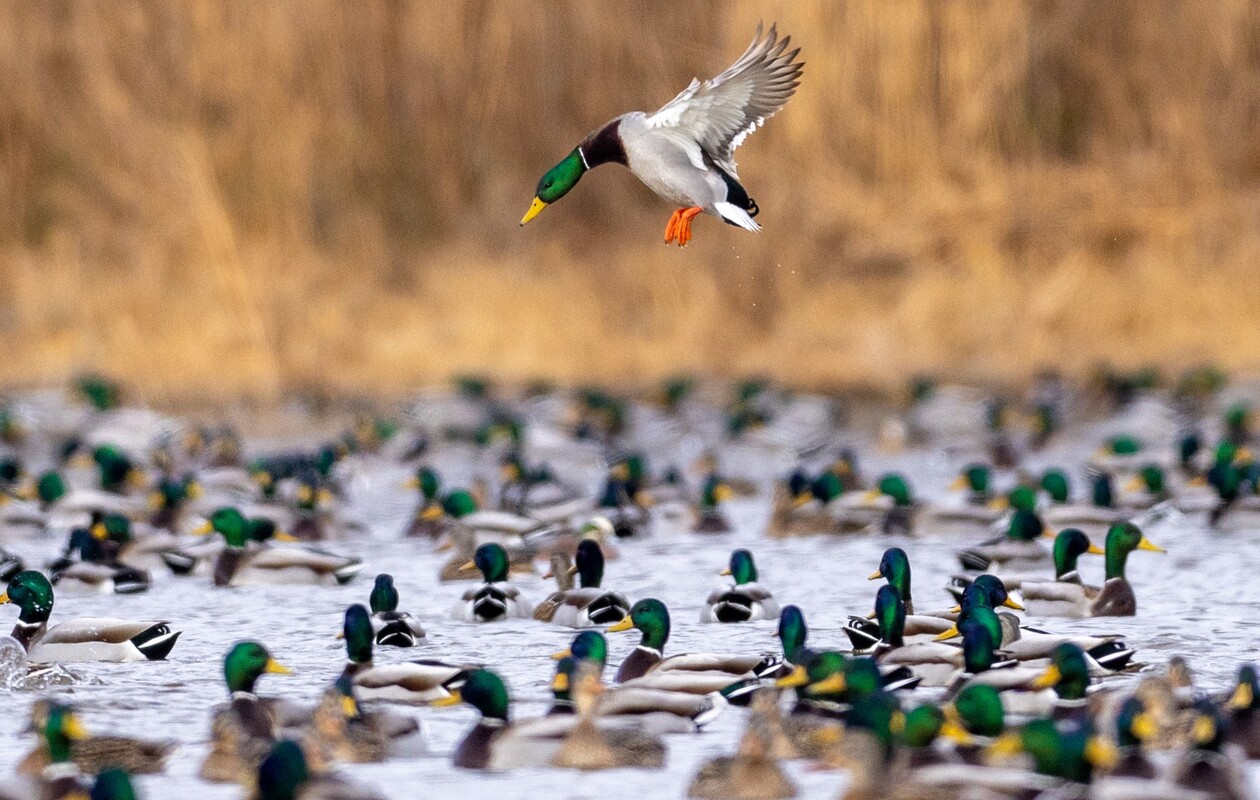
Beyond milder winters, climate change also brings greater year-to-year variability — extreme droughts, floods and unseasonal cold fronts — all of which can disrupt distributions in ways that are difficult to predict or manage. What we can say with confidence is that habitat is the variable managers can influence, making it the more productive focus regardless of how the question of causation is ultimately resolved.
Hunting Pressure
Pressure redistributes ducks, and the telemetry record supports this — once seasons open, birds concentrate on non-hunted refuges and largely stay there. Food, water and cover determine where they can winter; hunting disturbance determines where they will.
Pressure management is key. Everything else is secondary. A mallard will not develop site fidelity to ground where its survival is at risk, and with more than 100 days of legal shooting opportunity per year across the Mississippi Flyway, the cumulative disturbance is substantial. The two variables are inseparable, and managing one without the other leaves the equation incomplete.
If birds are concentrated on refuges from opening week through the end of January, what does a new hunter find when he steps into the Arkansas woods? Empty water and fading memories from the guy who hunted it in the 1990s. We cannot recruit hunters into an experience that has largely ceased to exist.
And the answer is not to open refuges to hunting — that misdiagnoses the problem entirely. We already have more pressure on the landscape than it can absorb. Refuges are not the reason hunting quality has declined; they are one of the last lines of defense against further decline. Eliminating them would accelerate redistribution onto the remaining private rest areas and remove large chunks of the landscape mallards need to conserve energy, forage, perform courtship and pair-bond before their flight back to the breeding grounds.
The pressure problem and the habitat problem are not separate issues competing for attention — they are the same redistribution story told from two different angles.
What We Know and What We Don’t
Drainage of PPR habitat remains the single greatest threat to mallards today, and the landscape changes occurring on the wintering grounds are producing effects we do not fully understand. We can name the factors, but we cannot yet assign proportional weight to each, and we are only beginning to understand how they interact at the landscape scale.
Modern agriculture restructured the caloric geography of the wintering grounds, and those effects are still unfolding. Mallards are highly plastic, responding quickly to food availability and disturbance by redistributing across the landscape, but they also display strong site fidelity when reliable, low-disturbance habitat is available season after season. That adaptability is what has allowed mallards to persist across a rapidly changing landscape, and it is both the challenge and the opportunity for managers.
Arkansas can still influence how many mallards winter here, but doing so requires deliberate, sustained investment in habitat quality and disturbance management.