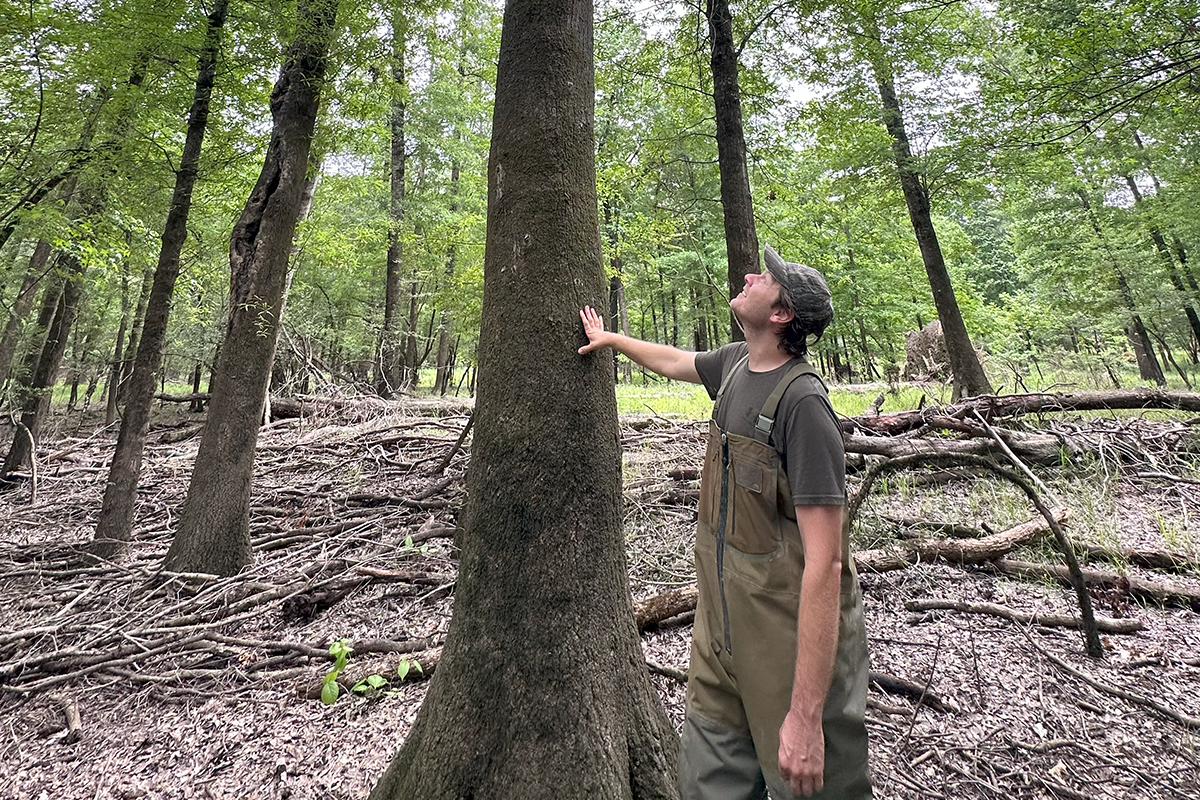
In Aldo Leopold’s seminal 1949 treatise “A Sand County Almanac,” he wrote, “Conservation is a state of harmony between men and land.” The book shaped modern thought on conservation, including Perrin Partee’s.
Originally from Magnolia, Partee fell in love with nature at an early age.
“I grew up living in the country, being surrounded by timberlands, and just by being affiliated with the land through our timber business, I fell in love with it,” Partee says.
Reading Leopold’s essays cemented Partee’s decision to devote his time to conservation. As land manager for Partee P1 FLP, Partee manages the family business’ finances alongside his efforts to preserve a portion of their land holdings, a 1,200 acre tract of mostly bottomland hardwood in Ouachita County, for wildlife habitat.
Moist soil management has been his primary focus, with the goal of providing high-quality, early successional wetland habitat for migrating waterfowl.
“We’ve taken existing wetlands and improved the water control on those,” Partee says. “I’ll do a disturbance every two-to-three years; if you don’t disturb it, it would turn back to timber — more woody vegetation would take over. Following the growing seasons, I’ll do a slow drawdown of water; that usually results in a good mix of grasses and sedges.”
He’s also worked to clear cut some of the loblolly pine that’s planted throughout south Arkansas, giving the native hardwoods that previously existed across the landscape the opportunity to regrow.
“We’ve been clear cutting those pine plantations as they reach maturity and then allowing them to naturally regenerate to bottomland hardwood,” Partee says.
Perrin has also taken an unconventional approach to managing low-value timber zones at WingSelect Farms: he lets beavers help.
“They do kill timber, but at the same time, dead trees provide a lot of habitat,” Partee said.
In the past decade, Perrin has seen his labor bear fruit. Through personal observations, he’s counted the number of waterfowl and other wildlife increasing over time.
“The reward, to me, is seeing, just about every year, right on schedule, like clockwork, they show up,” he says. “That tells me they are happy ducks. They know it’s safe, they know they won’t get pestered, they’ve got good habitat. … That’s the real joy.”
In the Hole
How can other landowners replicate your low-cost conservation efforts?
“Contact your district conservationist at the (Natural Resources Conservation Service), and that’s usually a great way to start to see if there’s any practices you can implement to be cost shared. Go online and look for PDFs from different universities, government agencies, (the U.S.) Fish and Wildlife (Service) — there’s a lot of material out there on moist soil management and other habitat practices.”
What has conservation taught you?
“Realizing everything is interconnected, from an ecological perspective.”